
Home electrical
Knob-and-Tube Rewiring in San Francisco
Knob-and-tube wiring investigation and replacement for San Francisco homes, from identifying what remains to permitted rewiring and inspection.
Request an estimateUnderstanding the system
What Is Knob-and-Tube Wiring?
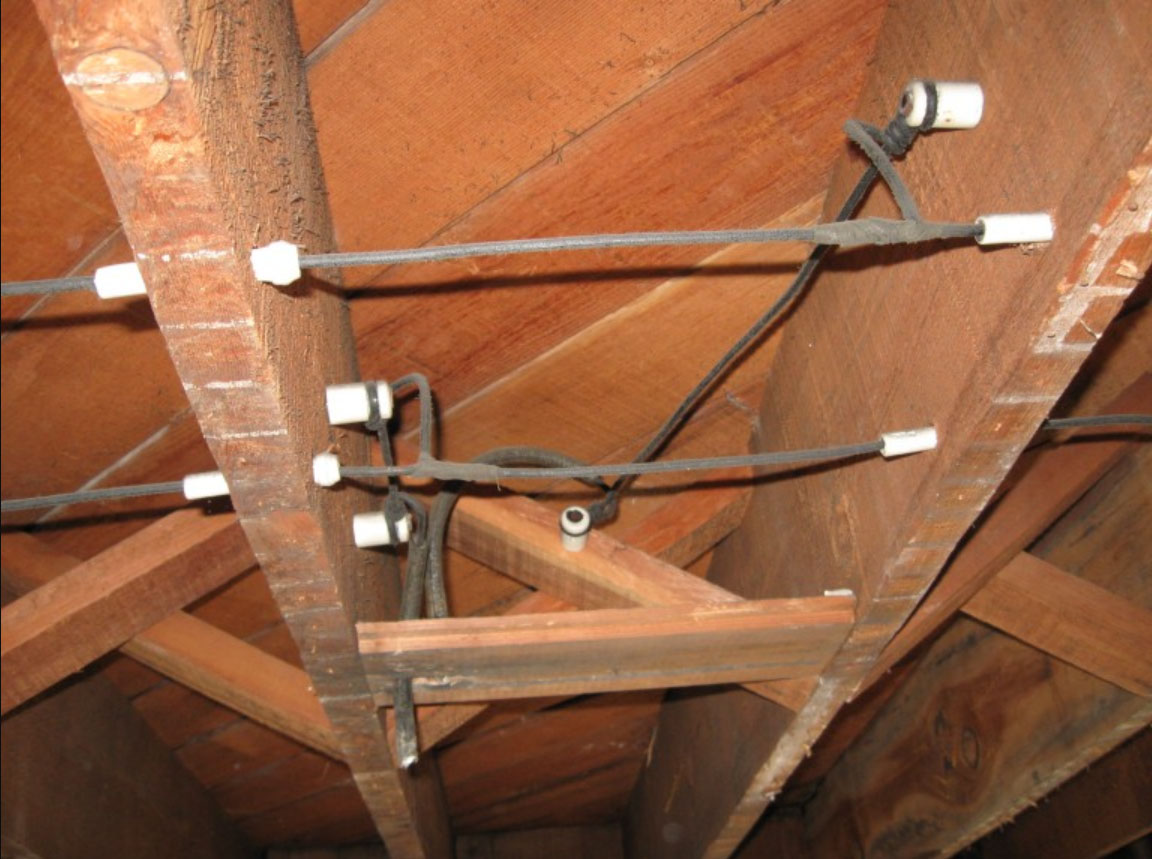
Knob-and-tube wiring is an early electrical system commonly found in San Francisco homes built from the late 1800s through the 1930s, with some installations continuing later. Individual insulated wires were run separately through the structure, supported on porcelain knobs and protected by porcelain tubes where they passed through wood framing.
When properly installed, knob-and-tube wiring was a reliable system for its time. Connections were mechanically joined, soldered, and insulated. Many older San Francisco homes still have some original wiring in areas that were never remodeled. Unlike modern wiring, however, most knob-and-tube circuits do not include an equipment grounding conductor.
Why it matters
Why Is Knob-and-Tube Wiring an Insurance and Fire Concern?
The biggest concern today is often not the original wiring itself, but what may have happened to it during 80, 100, or more years of repairs and remodeling.
Original connections were normally soldered. Later alterations were not always made to the same standard. We frequently find newer wiring added to old conductors by stripping the insulation and wrapping another wire around them without a proper connection.
Over time, a poor connection can loosen or oxidize, creating resistance, heat, and eventually arcing. The difficult part is that many of these altered connections are hidden inside walls and ceilings.
This combination of aging insulation, concealed alterations, lack of grounding, and improperly modified circuits is why knob-and-tube wiring has become an insurance concern. Some insurers require an inspection or rewiring before issuing or renewing coverage.
How much remains?
How Much Knob-and-Tube Wiring Is Still in Your House?
An older house does not necessarily mean an entirely knob-and-tube house.
Many San Francisco homes have been remodeled repeatedly. Kitchens, bathrooms, appliances, and newer outlets often have newer wiring. Originally, many houses had only two to four circuits serving much of the home, while today's panel may contain many more.
The greater the number of newer circuits, the more likely that portions of the house have already been rewired. But the panel alone cannot tell us exactly what remains, because newer wiring may connect to older knob-and-tube farther downstream.
The first step is therefore to determine which rooms, outlets, switches, and lights are still connected to the old system.
Knob-and-tube investigation
Room by Room. Item by Item.
Before recommending a major rewiring project, we can perform a detailed investigation throughout the house.
We inspect the system from both directions: from the electrical panel and accessible junction boxes, and from the outlets, switches, and lighting points throughout the property. Circuits may be selectively de-energized and traced to determine exactly what they serve.
When finished, we provide a room-by-room, item-by-item description identifying the outlets, switches, lights, and other locations that still contain knob-and-tube wiring and those that have already been rewired.
You are not obligated to hire us for the rewiring. The findings are yours and may be used to obtain estimates from other licensed electrical contractors. If you accept our rewiring estimate, the investigation fee is credited toward the project.
How we replace it
How We Replace Knob-and-Tube Wiring
Every outlet, switch, and lighting point still connected to knob-and-tube wiring is supplied with new wiring, typically modern nonmetallic cable such as Romex.
Where walls and ceilings are already open, rewiring is considerably faster and less expensive. In a finished house, we first try to fish new wiring through existing cavities. First-floor outlets can often be reached from a basement, garage, or crawl space, while upper-floor lighting can frequently be reached from an attic.
Where wiring must cross studs, joists, or blocking, small access openings may be required. If a general contractor, plasterer, painter, or drywall contractor is already involved, we can mark the required locations and have them make the openings before our electricians begin. This can substantially reduce electrical labor.
What Happens to the Old Knob-and-Tube Wiring?
The original knob-and-tube wire normally does not need to be physically pulled out of the walls. Once it has been completely disconnected, de-energized, and made impossible to reuse, it can remain abandoned inside the structure.
Where required, we replace old electrical boxes, install new outlets and switches, provide new ceiling boxes, and reconnect owner-provided fixtures to the new wiring.
Patching, plaster or drywall repair, and painting are not included in our electrical estimate. We can recommend experienced professionals who can provide that work separately.
Living in the house
Unoccupied Is Fastest, but Occupied Rewiring Is Possible.
The fastest and least disruptive situation is an unoccupied house, particularly before a new owner moves in. With little or no furniture in the way, electricians have better access and the work can proceed continuously.
When the house is occupied, the project can still be done. Furniture should be moved away from the walls, valuable or dust-sensitive items removed where possible, and remaining furniture covered. We protect the immediate work area and use vacuum-assisted cutting methods to reduce dust, although some construction dust is unavoidable.
If occupants cannot leave the property, we can sometimes divide the house into phases. One portion is rewired and inspected first, then patched and painted before work moves to the remaining area. This approach works, but it generally increases the overall project duration because the work and inspections must be completed in stages.
Typical timeline
Medium-sized San Francisco house requiring a complete knob-and-tube rewire.
Smaller house, or a property where substantial portions have already been rewired.
These timeframes cover the electrical work and inspections. They do not include the additional time needed for plaster or drywall repair and painting.
San Francisco experience
Rewiring & Knob-and-Tube Removal

Rewiring & knob-and-tube removal
114 selected completed electrical permits in San Francisco.
Part of our 1,700+ San Francisco electrical permits.
- Documented knob-and-tube removal · 58 permits
- Other rewiring · 56 permits
An outer ring around a filled dot indicates both classes at that location. Repeated permits share a dot. Documented removal may be partial; it does not always mean whole-house replacement.
Sources: DataSF electrical permits, street centerlines and analysis neighborhoods. Snapshot: September 9, 2026. “Complete” is the electrical-permit status, not proof of whole-project completion.
Request an estimate
Tell us what you're planning.
Include the project address and a brief description of the work. We will help identify the appropriate next step.